
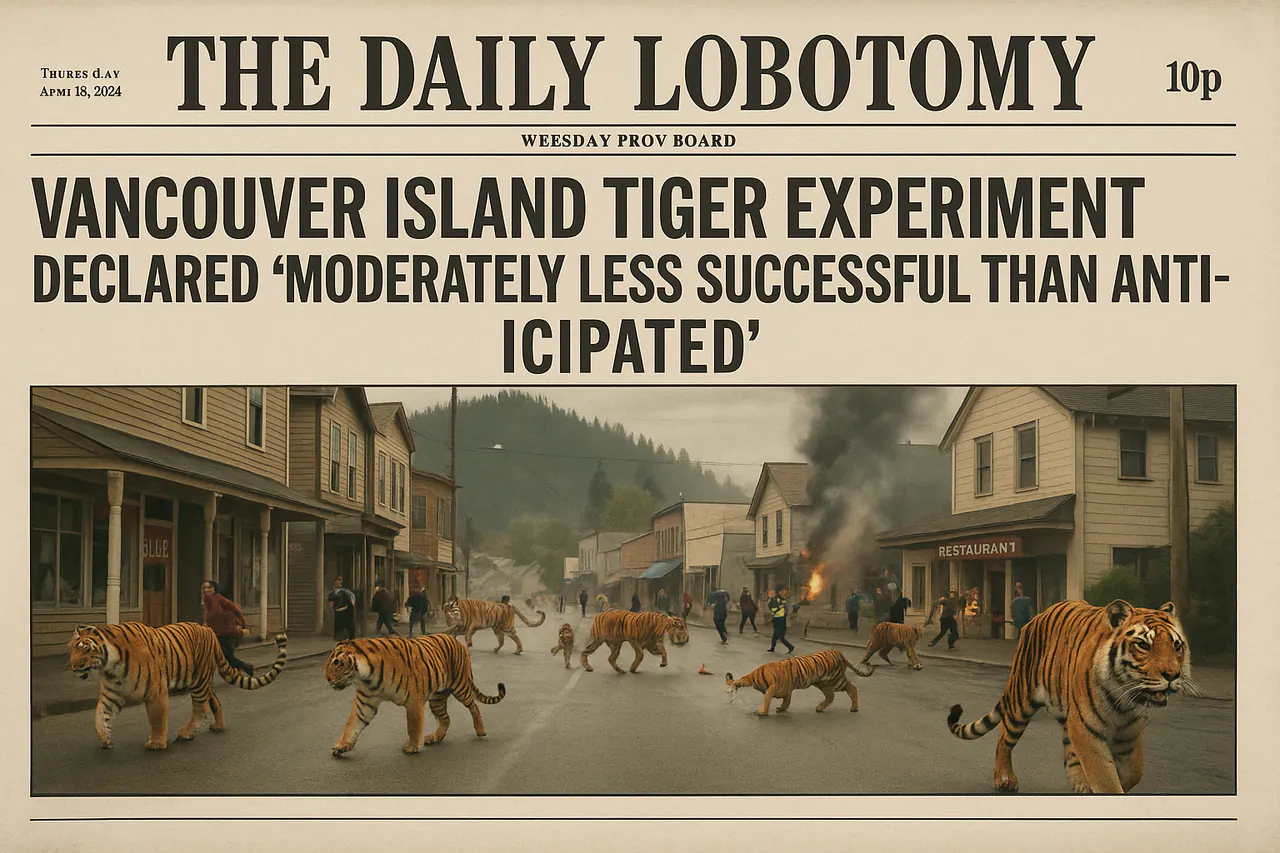
VANCOUVER ISLAND, BC – The grand experiment to “reinvigorate tourism” by releasing 5,000 Bengal tigers into Vancouver Island has been declared “a bit of a cock-up” by provincial authorities after a series of events best described as “the opposite of what we were going for.”
The Tigers for Tourism initiative began two years ago with a simple premise:
- Tigers eat deer.
- Vancouver Island has too many deer.
- Tourists like tigers.
- Ergo, release tigers, problem solved, money rolls in.
It was approved unanimously by a joint task force consisting of tourism officials, private investors, two zoologists who had been drinking heavily, and one man who thought he was there to pitch a children’s book about squirrels.
Ecological Breakdown (in which the deer vanish and so does everybody else)
For the first three months, everything went according to plan — deer numbers plummeted dramatically, followed shortly by the disappearance of domestic pets, livestock, hikers, cyclists, and one very unlucky brass band.
Unfortunately, no one had told the tigers that British Columbia is not, in fact, a steamy jungle but a damp fridge with mountains. Many tigers became cold, hungry, and — as experts put it — “irritated beyond all reason.” Starving big cats began wandering into schoolyards, bus stops, and knitting circles in search of “anything vaguely meat-shaped.”
One biologist summed up the problem:
“A starving tiger is a bold tiger. And a bold tiger is exactly what you don’t want sniffing the back of your Ford Fiesta while you’re stuck at a red light.”
Economic Fallout (or “How to make everyone leave in under a year”)
Instead of the tourism boom promised, the island experienced a dramatic reverse tourism effect, as visitors fled screaming and locals moved to the mainland. Property values collapsed, several towns were abandoned entirely, and businesses pivoted to selling “I Survived the Tiger Release” T-shirts — mostly to people who did not survive.
Local hospitals report a 300% increase in tiger-related trauma cases, prompting the provincial government to create a new public health department called The Ministry of Bandages.
Government Retrenchment (featuring impressive denial)
Officials have now abandoned “wildlife management” terminology in favour of the more direct “containment and not getting eaten.” An ongoing operation aims to track and relocate surviving tigers, though officials admit they have “no earthly clue” how many are still roaming the island.
The project’s mastermind, Dr. Hubert von Wildthing, has not been seen since last year’s “Bring Your Tiger to Work Day” went disastrously wrong.
Life on the Island (or what’s left of it)
Residents who remain live under strict “Don’t Look Like Lunch” guidelines:
- Always travel in groups.
- Avoid jogging, as it resembles “panicked prey behaviour.”
- Refrain from wearing orange and black stripes “for obvious reasons.”
Some citizens have constructed elaborate home defences, including tiger-proof sheds, moats filled with marmalade, and in one case, an elaborate decoy made entirely of Spam. Others burn large bonfires at night while chanting anti-tiger limericks, which experts say “probably doesn’t help but does keep morale up.”
Aftermath & Lessons (which will not be learned)
Independent audits have called the tiger release “a textbook example of what not to do, unless your textbook is written by lunatics.” There was no environmental impact study, no exit strategy, and most of the budget was spent on promotional brochures featuring smiling families who, tragically, were eaten before the photo shoot concluded.
The UN has condemned the project as “possibly the most irresponsible wildlife initiative since the Great Flamingo Airdrop of 1972.”
Cleanup is expected to take years, assuming the cleanup crew survives the first week. Officials say the island’s ecological balance may never return to normal, though they note the deer problem has been “solved in the most thorough way imaginable.”
One anonymous government source summed it up:
“It was an experiment in hubris, arrogance, and the logistical limits of stuffing a ferry full of tigers. On the plus side, we have all learned something important about the dangers of optimism.”