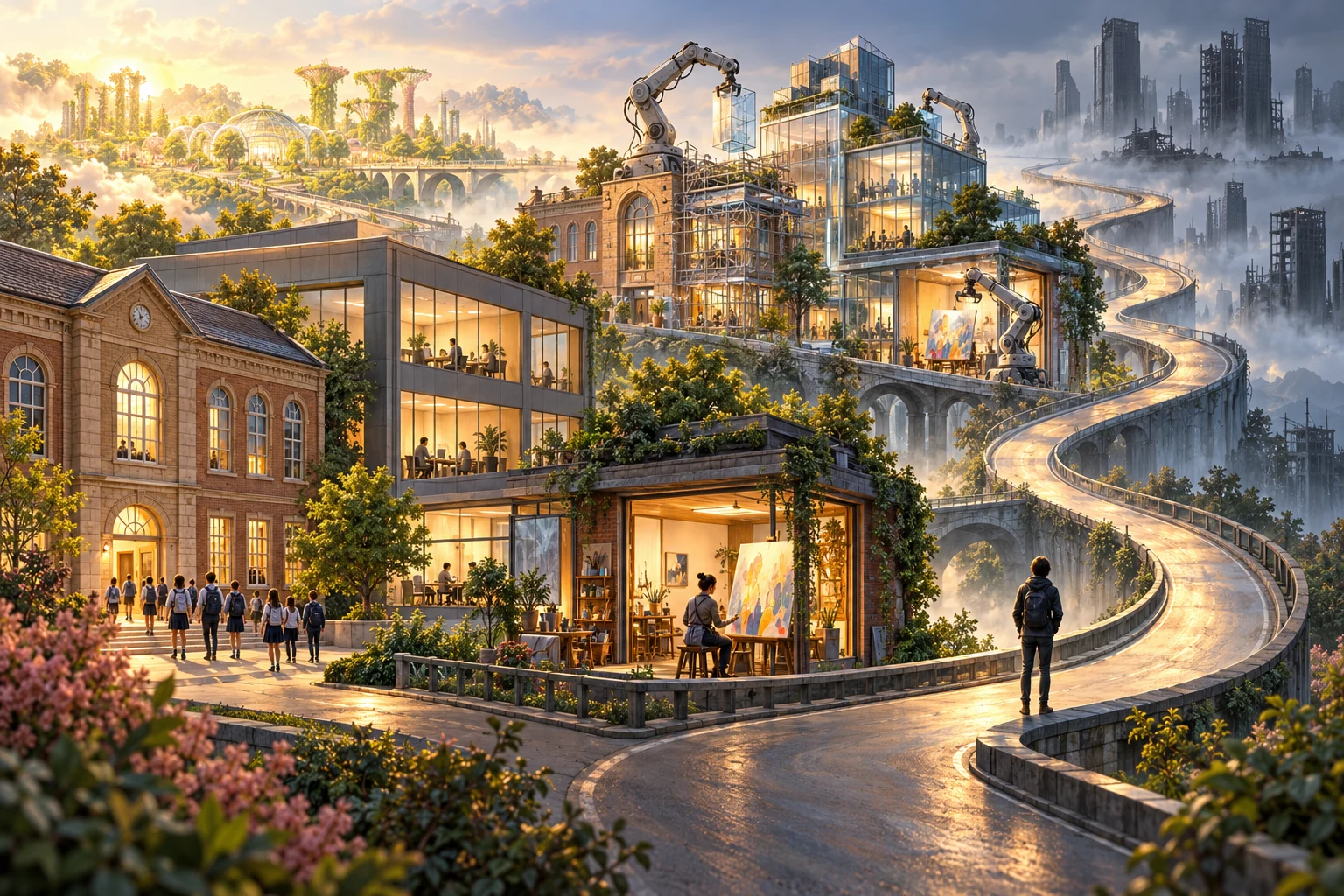
In the next 5 years, we are going to witness the transformation of human living on a level of greater significance than the Industrial Revolution. I have some predictions on some of the major impacts this transformation is going to have in various aspects of human society.
Short-Term AI Industry Predictions
This is the hardest to predict with any degree of accuracy in the long term; as such, I'm more focused on where we are now and the general direction of where it seems to be headed.
Currently, the AI industry is being flooded with dozens of new tools every day. It's far too much for anyone to keep up with and the reality is most of these products will not stand out from the crowd and will not last long in the industry. They cost too much to run, and the sheer amount of AI startups who want you to pay them $10/month is not sustainable. The big ones such as ChatGPT, Bing Chat, MidJourney are hard to miss. Meta, Adobe, and Google all have products coming that are worth paying attention to, but until the dust settles, it's hard to see which lesser-known companies will strike gold and set themselves apart from the pack. There's a lot of hype and a lot of companies making big claims, but only a tiny amount of what is being launched this year will ever be anything more.
Education
The transformation of the education system is already unfolding. ChatGPT has, in a few months, become widespread across education systems around the world. Students are using it to learn topics, answer their math questions, write their poetry, compose essays, and likely much more. Education will need to quickly adapt to a style essentially the opposite of what we have now. Rather than the teacher teaching and assigning written work, the teacher will tell the students what to learn about and orally test their knowledge in class or remotely, if need be. We are rapidly heading in a direction where teachers build their entire lesson plan using AI, which the students then answer using AI. Without drastic changes in the structure of the education system as mentioned above, the entire system will cease to have any value for anyone.
Creativity
Humans are going to need to rethink what creativity is. Writing, art, music will all turn into a collaborative process between human and AI. There will obviously be many who reject the usage of AI and the idea of integrating it into their creative process. See this fantastic post by Nick Cave. I think this rejection is admirable and personally see high value in completely human-made work, even if I use AI myself for many things. The tragedy is, even those who make completely genuine human work will be looked at with suspicion, especially if their work is truly good. Everyone will wonder, "Did an AI make this?".
Eventually, those who adamantly reject AI will get old and pass away. What about human creativity in 50 years? How many babies of 2023 will reject the use of AI when everyone around them is using it and it's completely integrated into their life? As admirable as I find the notion of those rejecting it contemporarily, I still see the eventual demise of how we currently view human creativity. I think it's a tragedy that there may never be another work like "Lord of the Rings," "War & Peace," or "A Song of Ice and Fire," where everyone reading it will think with wonder, "How was this masterpiece created by a human?".
Economy
The idea that AI is going to suddenly eliminate most jobs is a misrepresentation of the problem. What it is going to do is make a vast amount of jobs 80-90% more efficient and thus require 80-90% fewer people employed. This is going to happen across a widespread number of industries, including (in the order listed) education, journalism, accounting, customer service (both phone and online), legal, IT, and retail. A few years later, when self-driving vehicles become widespread, you can add driving and agriculture to this list. It's not hard to imagine what this is going to do to the economy. Societies across the globe will find themselves in the same situation; enact policies to adapt to the new way of the world, such as universal basic income, or allow mass poverty and starvation.
To briefly address the most likely counterargument, of why not pass laws to stop this; it's rather simple. AI speeds productivity and the rate of innovation at such an astonishingly rapid pace that any nation that does this, or body of nations such as the UN, will find themselves at such a severe economic disadvantage that the countries that continue to use AI will dominate the world, most likely China. If I had to guess, China will be the first country to enact a full UBI for all its citizens. The benefits for their society will vastly outweigh what will happen if they don't.
Mental Well-Being & The Meaning Crisis
As a direct result of the loss of jobs discussed above, in addition to other factors, the meaning crisis that arose in the age of social media is going to reach new heights. This is of course one path we may go down and ultimately the much more positive one as bleak as it may seem; none of this will matter if we go down the other one. Much of the discourse on AI is around the doomsday scenario, so I don’t feel the need to talk about it at length, check out Max Tegmark, Geoffrey Hinton and Eliezer Yudkowsky for more on this in addition to some of the things written about here.
Without a job or any jobs remaining to be had, assuming we adopt universal basic income and don’t go down the other path, many people are going to need to find something to do with their time. Many will thrive in this way of living and create music, art, and write (or prompt an AI to do these things for them). Many more will experience depression and turn to drug abuse and suicide; familiar problems will be accelerated by a lack of purpose and an excess amount of time. With AI able to do nearly everything a person can and people increasingly feeling a loss of meaning and purpose, individuals will need to find ways to give themselves meaning and purpose. This is a crisis we can get through, but many people won't be able to get through it, and we'll need to completely reframe how we think about many things. As there is too much to say about this topic to put in an essay, for those interested in the meaning crisis and what you can do to adapt, I highly recommend John Vervaeke's series on Youtube. The first video is from 4 years ago and it’s not focused on AI but he hits at the heart of the problems we are facing with finding meaning in an increasingly isolated world.